

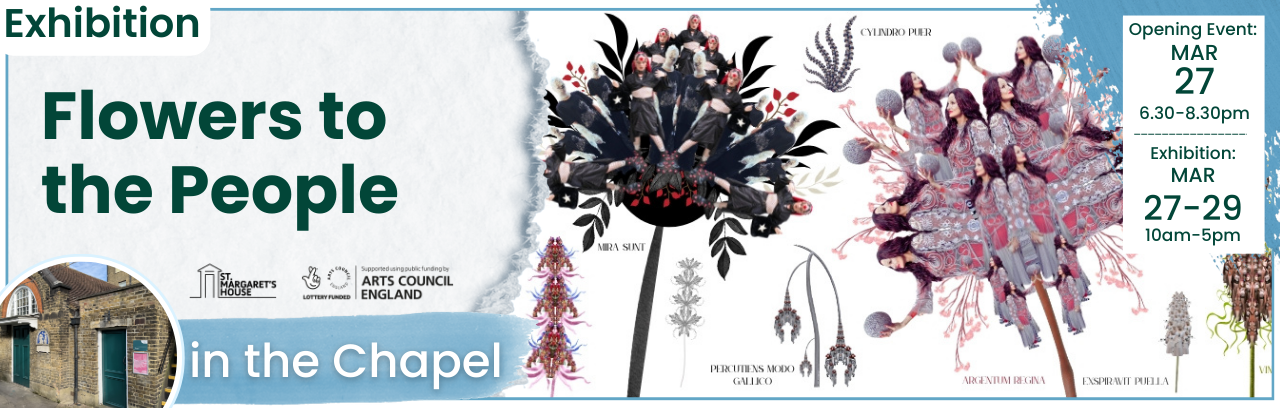
Flowers To The People responds to a central contradiction of contemporary life: unprecedented digital connectivity alongside deepening disconnection—from nature, from one another and from ourselves.
While digital technologies promise access and infinite possibility, they increasingly mediate and diminish lived experience. Nature is flattened into content, identity into data and human presence into metrics optimised for extraction. At the centre of this shift lies the hegemony of Big Tech and surveillance capitalism that increasingly enclose the digital commons - commodifying attention, creativity and intimacy.
This project emerges as a direct challenge to that condition.
At its core are photographic portraits digitally reimagined as flora and fauna. These hybrid figures dissolve the false boundary between the human and the ecological. Nature is not presented as an external landscape to be consumed, but as embodied, intimate and inseparable. Each specimen asserts a fundamental truth obscured by digital culture: we are not apart from nature—we are nature.
By echoing the visual language of botanical illustration—presenting works as specimens with invented Latin names—Flowers To The People confronts historic systems of classification, ownership and colonial control that catalogued life in order to dominate it, much like today’s digital culture. By reclaiming and subverting this form, the project inverts its power: these are not specimens gathered for extraction, but portraits offered in defiance.
The use of digital collage is intentionally paradoxical. The project employs the very tools implicated in alienation to resist it. Where platforms fragment attention and flatten complexity, these works seek reintegration. Where algorithms reward conformity and optimisation, the portraits celebrate self-expression, eccentricity and unruliness—honouring the passions and contradictions through which we become gloriously unique, affirming that we, natural life - ever-evolving and dazzlingly diverse - exceed all systems of control.
The exhibition is accompanied by an original soundscape made by the artist.
About Catastro/FILLE (Suke)
I’m Catastro/FILLE (Suke) — a genre-fluid, mixed-media artist and musician working across graphic design, photography, film, music, performance and installation. My practice is rooted in community and collective expression, celebrating the spaces I move through, the communities I belong to and the people I encounter. My work is instinctive and playful, often coming from an activist standpoint. I’m inspired by the body, movement, sensuality and our symbiotic relationship with the natural world. My background in community arts, heritage, journalism and social housing grounds the ethics and aesthetics of my work.
I currently work p/t as a Creative Digital Tutor for an addiction recovery charity in Shoreditch.
Contact: If you have any questions regarding this exhibition, please email programming@stmargaretshouse.org.uk
Venue: The Chapel at St Margaret’s House, 21 Old Ford Road — E2 9PL
Access: We are working to make our Grade II listed building more accessible, but it will take some time. Please note that entry to the Chapel is not step-free. If you require access support (including our portable ramps) and/or access to an accessible toilet, please contact us on 020 8980 2092 or email programming@stmargaretshouse.org.uk so we can arrange this for you.
Opening Event: Friday 27th March, 6.30-8.30pm
Exhibition: Saturday 28th - Sunday 29th March, 10am-5pm
Tickets for the Opening Event are free, but registration is essential